System Movie 2026 Movierulez Review Details
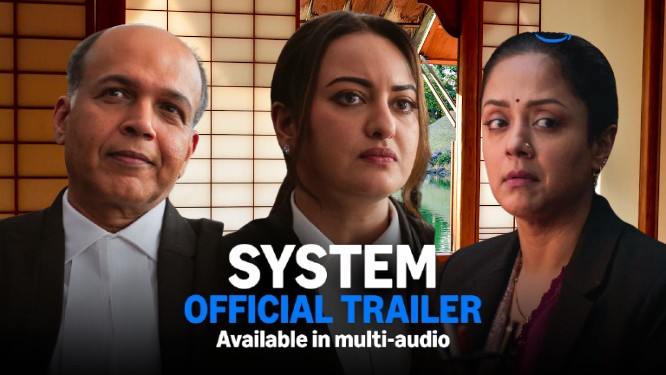
System (2026) Review – A Courtroom Thriller That Questions the Scales of Justice: Does It Tip in Your Favor?
I walked into System with a certain skepticism—another courtroom drama about a corrupt judiciary? But what I found was a film that doesn’t just wave the flag of justice; it interrogates the very hands that hold the scales.
This is not a film for those seeking easy catharsis. It’s a slow-burn, morally ambiguous character study that uses the law as a battlefield for a much deeper war: the war between privilege and truth.
Synopsis: The Core Conflict
Neha Rajvansh is a star public prosecutor from a wealthy family, who believes the legal system is a tool for order. Sarika Rawat is a courtroom stenographer from a lower-middle-class background, who believes the system is a tool for survival.
When a high-profile case exposes a conspiracy that threatens to bury a critical piece of evidence—buried in Sarika’s stenographic notes—their worlds collide.
The film asks: Can the system correct itself, or is it designed to protect the powerful?
| Role | Name |
|---|---|
| Director | Ashwiny Iyer Tiwari |
| Lead (Prosecutor) | Sonakshi Sinha |
| Lead (Stenographer) | Jyotika |
| Supporting (Antagonist) | Ashutosh Gowariker |
| Music Composer | OAFF |
| Producers | Pammi & Harman Baweja |
Section 1: Who Is This Movie For?
This is a film for the thinking audience, not the casual popcorn crowd. If you enjoyed Jolly LLB but wished it had less comedy and more grit, or if you admire the procedural realism of Section 375, System is your territory.
It is specifically designed for OTT viewers who value dialogue, subtext, and performance over spectacle. It might frustrate viewers expecting a “masala” verdict in the finale.

Section 2: Script Analysis – A Dense, Slow-Burn Architecture
The script is a maze of legal jargon and moral dilemmas. The first act is deliberately slow, setting up the power dynamics of the courtroom with painstaking detail. This is both a strength and a weakness.
Flow & Logic: The narrative structure is sound. It follows a classic three-act arc: the crime, the investigation, the trial. However, the pacing is uneven.
The middle act—where Neha begins to doubt the system—is brilliantly tense, using short, sharp scenes of her questioning witnesses. The logic holds up well, except for one plot convenience where a key document is discovered almost too easily.
Pacing Issue: The first 30 minutes are a slog of exposition. Director Tiwari assumes the audience is patient. She is correct, but this patience is tested by the repetitive nature of the initial hearings. The film recovers magnificently once Jyotika’s character becomes active.
Section 3: Character Arcs – The Real Victory of the Film
This is where System truly excels. Both protagonists undergo significant, believable transformations.
Neha (Sinha): She starts as a confident, almost arrogant enforcer of the law. Her arc is a painful realization of her own blind spots.
She does not become a saint; she becomes a person who must choose between her career and her conscience. Sinha delivers a career-best performance in the final cross-examination scene.
Sarika (Jyotika): The true heart of the film. She is a witness who becomes a target. Her arc is about agency. She starts as a silent observer, literally recording events without participating.

By the climax, she is the one who forces the truth into the record. This is a masterclass in understated acting.
Section 4: The Climax Impact – Satisfying but Uncomfortable
The ending does not offer a clean victory. The verdict is not a thunderous “guilty” that destroys the corrupt. Instead, it is a quiet, procedural defeat for the conspiracy, but a defeat that feels hollow because the “system” remains intact.
The final shot—a close-up of Sonakshi Sinha looking at a blank legal pad—is haunting. It does not provide the adrenaline of typical thrillers, but it provides the emotional weight of a pyrrhic victory.
It works.
| What Worked | What Didn’t |
|---|---|
| Realistic legal procedures | Overly slow first act |
| Strong character development | Predictable corrupt bureaucrat trope |
| Taut middle act tension | Lack of a memorable villainous monologue |
| Unconventional, quiet ending | Underutilized supporting cast (Gowariker is wasted) |
Section 5: Writer’s Execution – Dialogue as a Weapon
The dialogue by Akshat Ghildial is sharp, sparse, and legalistic. There are no punchy one-liners. Instead, the tension is built through what is not said.
A scene where the judge asks for a “break” during a crucial testimony is chilling because of the pause, not the words. The writing is excellent at showing the power dynamics through small words.
“Approach the bench” becomes a threat.
Section 6: Miss vs Hit Factors
The Hit: The central dynamic between the two women. The film does not treat them as rivals or victims. They are two professionals from different strata who find a common enemy.

This is a refreshing take on the “female-led courtroom drama” where they are not fighting for a man, but for a principle.
The Miss: The film is too cautious. It avoids the truly violent or visceral moments that a story about judicial corruption often demands.
There is no physical threat that feels real. The villain is a shadow, not a person. The script misses the opportunity to make the audience truly angry.
It stays cerebral when it should be visceral.
Section 7: Technical Brilliance – The Sound of Silence
Music (OAFF): The score is a minimalist masterpiece of dread. OAFF uses a droning bass note that flutters at the edges of hearing. It is deeply uncomfortable. There are no songs to break the mood, which is a brave choice.
Cinematography: The camera is mostly static, using medium shots that trap the characters in the frame. The lighting is cold and flat, resembling an actual courtroom.
The color grading is desaturated, making the skin tones look pale under the fluorescent lights. It feels like a documentary, which enhances the realism.
Editing: The film is edited with a keen sense of rhythm. The cross-examination scenes are cut in a rapid, staccato style that mimics the back-and-forth of legal arguments. The quieter scenes are allowed to linger, creating a strong contrast.

| Aspect | Rating/Comment |
|---|---|
| Narrative Depth | 9/10 – Complex, mature, requires patience. |
| Performance (Sinha) | 8.5/10 – Her best work, nuanced and controlled. |
| Performance (Jyotika) | 9.5/10 – A masterclass in silent resilience. |
| Dialogue | 8/10 – Sharp but sparse, lacks bombast. |
| Music & Sound | 8/10 – Exceptional ambient score, but underutilized in emotional peaks. |
| Visual Aesthetics | 7/10 – Functional and realistic, not beautiful. |
| Pacing | 6/10 – First act is a dead weight. |
| Climax Satisfaction | 7.5/10 – Intellectually satisfying, emotionally dry. |
3 FAQs
1. Is the ending a cliffhanger or is the case resolved?
The case is resolved, but the moral dilemma is not. The verdict is given. The “system” survives. It is not a cliffhanger, but it is an open-ended hook.
2. Is the film based on a true story?
No, but it is inspired by several real-life cases involving judicial privilege and witness coercion in the Indian legal system. It is a composite, not a biopic.
3. Why is the audio mix so quiet?
This is intentional. The film relies on the ambient noise of a courtroom—the shuffling of papers, the creak of the bench—to create tension. The low mix forces you to lean in, mirroring the characters’ desperation to hear the truth.
This analysis is based on the theatrical experience and cinematic merit.
Was this trade analysis helpful?
Your feedback helps Movierullz editors maintain trade database integrity.