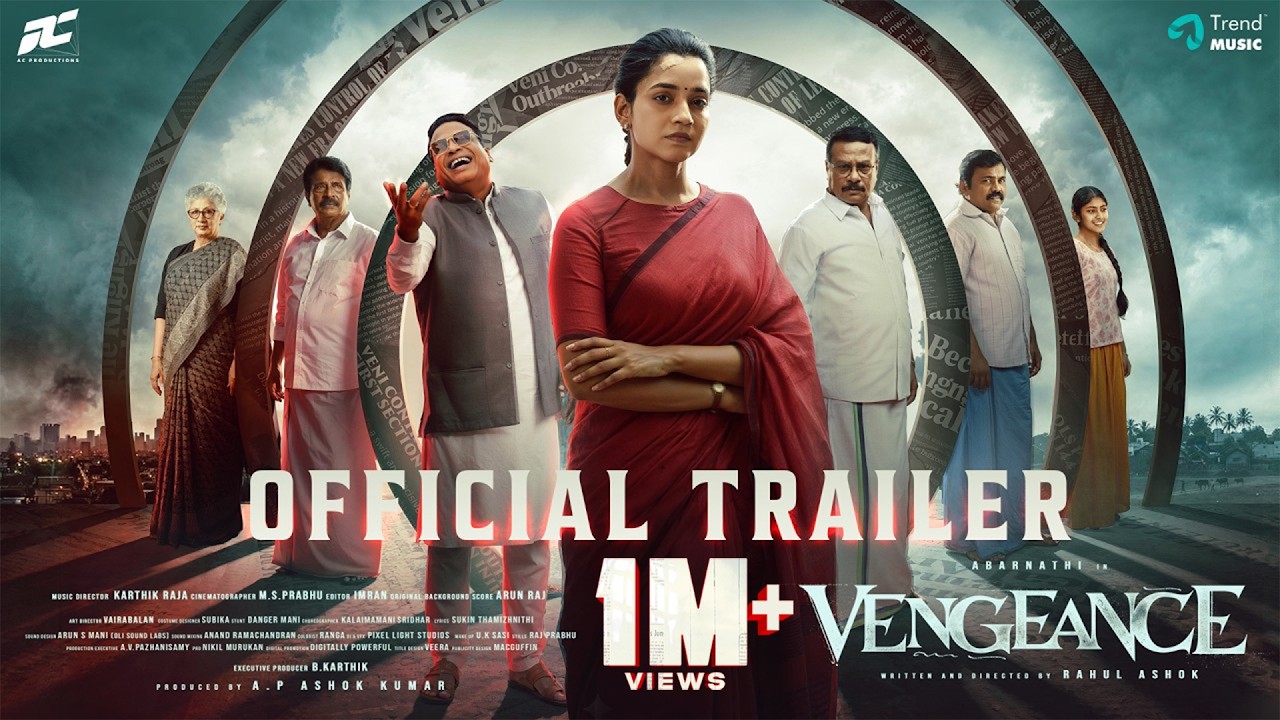
Vengeance Tamil Movie 2026 Movierulez Review Details
Vengeance (2026) Review – A Ruthless Thriller or a Political Misfire? The Real Analysis
As the lights dimmed, I hoped for a sharp, contemporary political fable. What I witnessed was a film so enamored with its own supposed cleverness, it forgot to build a coherent world around its compelling central performance.
The Core Conflict
Vengeance follows Veni, a district collector whose addiction to public fame (“pugazh bodhai”) is as potent as any drug. She meticulously crafts a saintly image through media stunts while secretly running a vast extortion racket.
When the news cycle ignores her, she triggers political chaos, revealing a lifelong, pathological need for adoration that morphs into a mission of ruthless revenge.
| Role | Name |
|---|---|
| Veni (District Collector) | Abarnathi |
| CM Velu | Ilavarasu |
| Madhav | John Vijay |
| Foster Father | Kaali Venkat |
| Director & Writer | Rahul Ashok |
| Cinematographer | M.S. Prabhu |
| Editor | Imran |
Who Is This Movie For?
This film is a niche offering. It will resonate only with die-hard fans of Abarnathi, eager to see her command the screen in a morally grey lead. Viewers seeking a straightforward, logically sound political thriller should steer clear.
It’s also a curious case study for cinephiles interested in debut missteps—how a potent premise can be undone by repetitive storytelling and tonal inconsistency.

Script Analysis: The Fatal Flaw of Repetition
The screenplay is where Vengeance collapses under its own weight. It operates on a single, recycled trick. A new character or threat is introduced, tension is feebly mounted, and then—reveal!—they were secretly working for Veni all along.
This happens not once or twice, but repeatedly, draining every scene of genuine suspense. The plot progresses via disconnected vignettes that reset the stakes instead of escalating them.
The jump from local corruption to high-stakes national politics feels unearned, a narrative leap without logical groundwork.
Character Arcs: A Solitary Pillar
Abarnathi’s Veni is the only character with a defined, if uneven, arc. Her transition from calculated image-maker to unhinged avenger is visible, carried by the actor’s cold, focused performance.
The chilling flashback of her murdering her foster father for praise is the film’s most potent character beat.

Unfortunately, everyone else is a pawn in her game, in the most literal and dramatically inert sense. Veterans like Ilavarasu and John Vijay are reduced to one-note plot devices, their potential squandered in service of the next hollow “twist.”
The Climax Impact: An Inevitable Whimper
By the time the climax arrives, the film has cried wolf too many times. Any intended shock or catharsis is muted because the pattern is numbingly familiar. The ending doesn’t feel like an organic culmination of built-up conflict, but merely the final stop on a meandering, predictable route.
It satisfies only in the sense that the journey is over, leaving behind a residue of wasted potential rather than thematic resonance.
| What Worked | What Didn’t |
|---|---|
| Abarnathi’s compelling, cold lead performance. | The repetitive “secret ally” twist structure. |
| The sharp, satirical premise of fame addiction. | Disconnected, momentum-killing vignettes. |
| Competent sound design and action choreography. | Underwritten, wasted supporting cast. |
| The chilling core idea of Veni’s pathology. | Illogical action beats and unearned plot escalation. |
Writer’s Execution: Ideas Over Craft
Director-writer Rahul Ashok demonstrates an understanding of a potent contemporary theme: the intoxication of viral fame and performative morality. The dialogue occasionally crackles with cynical insight into the political-media ecosystem.
However, the craft of weaving these ideas into a gripping, logical narrative is absent. The plotting is amateurish, relying on repetition over development. The script feels like a collection of “cool scenes” in search of a backbone to connect them.

Miss vs Hit Factors: The Great Divergence
The hit is singular and significant: Abarnathi. She embodies Veni with a steely, unsettling calm that makes you wish the film around her was worthy. Her performance is a masterclass in portraying menace through stillness.
The misses are myriad. The fatal miscalculation is the repetitive structure. Furthermore, the use of jarring, low-quality AI-generated visuals breaks immersion in a theatrical film.
The pacing is erratic, and the decision to keep every other character as a shallow archetype prevents the world from feeling real or threatening.
Technical Brilliance: A Mixed Bag
M.S. Prabhu’s cinematography capably frames the political and personal spaces, though it lacks a distinctive visual signature. The sound design by Arun S Mani is a standout, adding much-needed tension to the action sequences.
Editing by Imran contributes to the disjointed feel, failing to create a rhythmic flow. Most damning is the inclusion of subpar VFX and AI slop, which feels cheap and distracting, undermining the film’s intended gritty realism.

| Aspect | Rating / Comment |
|---|---|
| Story Concept | High Marks. A brilliant, timely premise about fame and power. |
| Story Execution | Very Poor. Repetitive, illogical, and disjointed. |
| Visual Consistency | Uneven. Competent cinematography marred by cheap AI/VFX. |
| Lead Performance (Visual) | Excellent. Abarnathi’s physicality and expressions carry the film. |
| World-Building | Weak. The political landscape feels shallow and unconvincing. |
Frequently Asked Questions
What is Veni’s real motive? Her core motive is an insatiable, pathological addiction to public praise and fame (“pugazh bodhai”). Her actions, from childhood to her political schemes, are all designed to feed this addiction, which eventually morphs into a vengeful quest for control.
Why are the plot twists criticized? The twists are criticized because they are all identical. Every apparent enemy is revealed to be Veni’s pawn, a trick used so repeatedly it becomes predictable by the third act, destroying all narrative suspense.
Is the film based on a true story? No, Vengeance is a work of fiction. It creates an imaginary socio-political backdrop to explore its themes of corruption, fame, and moral decay, though it draws inspiration from real-world dynamics of media and power.
This analysis is based on the theatrical experience and cinematic merit.
Was this trade analysis helpful?
Your feedback helps Movierullz editors maintain trade database integrity.