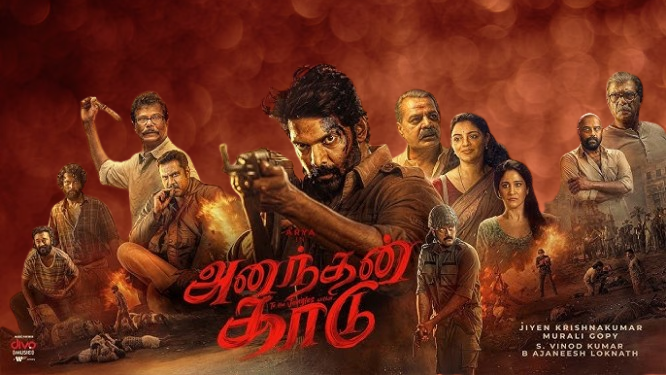
Ananthan Kaadu Movie 2026 Movierulez Review Details
Ananthan Kaadu Review – A Forest of Intrigue or Just a Tangle of Missed Potential? The Real Analysis
I walked into the theater expecting a loud, commercial mass entertainer. What I got was something far more restrained—a politically dense thriller that breathes through its silences rather than its explosions.
Does that make it a better film? Yes. Does it make it an easier watch? No. Here is the unflinching breakdown.
The Core Conflict: A Man Caught Between Power and Survival
Vetri, played by Arya, is an ordinary man thrown into the deep end of a territorial battle rooted in the political history of Thiruvananthapuram. He is not a hero with a catchphrase.
He is a survivalist navigating factional violence, ideological pressure, and personal loss. The forest isn’t just a backdrop—it’s a character that swallows ambition whole.
Main Cast & Crew
| Role | Name |
|---|---|
| Director | Jiyen Krishnakumar |
| Writer | Murali Gopy |
| Lead Actor | Arya |
| Key Cast | Murali Gopy, Dev Mohan, Sunil |
| Supporting Cast | Indrans, Appani Sarath, Vijayaraghavan |
| Music Composer | B. Ajaneesh Loknath |
| Producers | S. Vinod Kumar, Gokulam Gopalan |
Who Is This Movie For?
This is not a film for the Friday night crowd looking for mass dance numbers and instant gratification. It is built for viewers who appreciate political drama layered with moral ambiguity.
If you liked Jallikattu or Virus for their ensemble tension, you will find similar territory here. The casual multiplex audience? They will check their phones before the interval.

Script Analysis: The Weight of Ambition
Murali Gopy’s screenplay is dense, sometimes to a fault. The first act struggles with exposition overload. Characters are introduced in rapid succession, and the political backstory requires patience.
The pacing picks up in the second half when the tension becomes personal rather than ideological. The logic holds, but the film’s rhythm is uneven—moments of intense confrontation are followed by long stretches of quiet buildup that test your attention span.
Character Arcs: Growth or Stagnation?
Arya’s Vetri starts as an observer and ends as a reluctant participant. His transformation is subtle, not dramatic. That works for the tone, but it denies the audience a cathartic emotional release.
Murali Gopy as Thankaraj Ponnappan is the magnetic anchor—every scene he enters, the temperature rises. The supporting cast is excellent, but several characters, including Nikhila Vimal’s Deepa, are underutilized.
They exist to service the plot, not to live beyond it.
The Climax Impact: Resolved or Rushed?
The climax is where the film nearly loses its grip. It resolves the central conflict with a confrontation that feels earned in concept but rushed in execution.

The emotional payoff is muted because the film prioritizes ideological closure over personal closure. You will understand why things ended the way they did.
You will not necessarily feel it.
Screenplay Highs & Lows
| What Worked | What Didn’t |
|---|---|
| Strong political subtext and layered dialogue | First act suffers from character overload |
| Atmospheric tension built through silence | Pacing is uneven, especially in the middle |
| Murali Gopy’s performance as antagonist | Several supporting arcs feel incomplete |
| Realistic moral ambiguity in central conflict | Climax lacks emotional punch despite tension |
Writer’s Execution: Words That Carry Weight
The dialogue is sharp where it matters. Murali Gopy has a gift for writing confrontations that feel less like shouting matches and more like chess games.
The bilingual format gives the script a wider linguistic palette, but it also creates occasional tonal dissonance between the Tamil and Malayalam versions.
Some lines land better in one language than the other. The film trusts its audience to pay attention—there is no spoon-feeding here.
Miss vs Hit Factors: What Went Right and Wrong
The biggest hit is the atmosphere. The film uses its forest setting not as a gimmick but as a pressure cooker. The sound design, the muffled conversations, the distant crack of branches—it all builds a sense of inevitable violence.

The biggest miss is the market understanding. This movie was positioned as a commercial thriller, but it plays like an indie political drama. The ₹60 crore budget demands mass appeal.
The script delivers niche engagement. That tension is why the box office numbers collapsed.
Technical Brilliance: Sound, Light, and Rhythm
B. Ajaneesh Loknath’s score is restrained and effective. It does not overshadow the scene—it amplifies the unease. The cinematography captures the forest’s claustrophobia without making it look like a postcard.
The editing, however, needed a firmer hand. Several scenes linger too long, and the runtime of 2 hours 37 minutes feels self-indulgent. The VFX work is minimal but functional—this is not a film that relies on spectacle.
Story vs Visuals
| Aspect | Rating / Comment |
|---|---|
| Script Depth | Strong political foundation, uneven pacing |
| Performance | Arya solid, Murali Gopy steals the show |
| Cinematography | Moody and effective, restrained framing |
| Music & Sound | Atmospheric score, good tension building |
| Commercial Appeal | Low. Niche audience only |
3 FAQs – Plot Related Queries Answered
1. Is Vetri based on a real person?
No. The character is fictional, though the political dynamics and territorial conflict draw from real historical tensions in the Thiruvananthapuram region.
2. Why does the film switch between Tamil and Malayalam?
The bilingual format reflects the geographic and cultural overlap of the story. It was shot in both languages to maximize regional reach, but the tonal shift can be jarring for single-language viewers.

3. Is the ending open for a sequel?
It is ambiguous. The central conflict is resolved, but the final scene leaves room for continuation. The box office performance makes a sequel unlikely.
This analysis is based on the theatrical experience and cinematic merit.
Was this trade analysis helpful?
Your feedback helps Movierullz editors maintain trade database integrity.